As I'm wrapping up my time in the Holy Land, it's only appropriate to
be here in Jerusalem. This trip has been nothing less than a shocking
mix of images, cultures, time periods, and traditions. Therefore, it
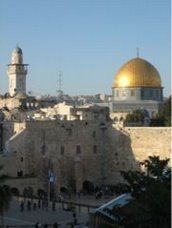
just seems right that I should walk by a piece of Solomon's temple on
my way to breakfast, eat lunch within view of Islam's third-holiest
site, and sit at a computer on the street where Jesus carried his
cross, all before hopping on a jet plane to return home this evening.
Our team made the short bus ride from Hebron to Jerusalem on Friday
morning, just in time to find a falafel sandwich and get over to
Sabeel. It took a while to readjust to lunch prices back in Jerusalem
- a falafel sandwich jumped from 3 sheckels (75 cents) to 6 scheckels
(a buck fifty). Then our final appointment of the trip brought us to
Sabeel, an organization of Christians who have lived in the area
anywhere from a couple hundred to a couple thousand years. They see
this conflict as a continuation of violence which began long, long
ago. The Germans were exploited and destroyed after WWI, then they
exploit and destroy Jews during WWII, and we see the same process
developing again in Israel's policies toward arabs. Their work is to
end this cycle, working with both the Palestinians, so this cycle
stops here, and the Israelis, who are imposing an occupation that is
"illegal, immoral, and destroying lives on a daily basis." Before I
left the U.S., I didn't realize that the local population had been 20%
Christian before 1948, and that they suffer alongside their fellow
arabs in this conflict. In fact, we've met Christian communities in
Bethlehem and Jerusalem who describe their struggles to continue their
lives under occupation. In fact, there's a Christian village north of
Jerusalem I haven't visited yet, but which has endeared itself to me
in a special way. They produce the West Bank's only micro-brew.
Honest. It's called Teybeh (pronouned tie-bay), and I think it's also
being made now in England, so we may be able to find it in the states.
You see, one gets all kinds of important information on a trip like
this.
Once in Jerusalem, I was able to visit the Holocaust museum and
Masada, two of the most important symbols for today's state of Israel.
If you're like me and are unfamiliar with Masada, it's the site of
the Jewish rebels last stand against the Roman army in their revolt
around 70 CE. What's more impressive is that the "last stand" lasted
over 2 years. We took the bus there, and as you approach it from the
Dead Sea, you can see how they held out so long - it's a massive
stand-alone tower of rock over 600 feet high with about 2 or 3 acres
of flat space on top. The roman army eventually built a ramp to the
top, and when they entered, the entire troop of rebels had committed
suicide. Today, the Israeli army holds its swearing in ceremony at
Masada, saying that 'Masada will never fall again.' One can see why
it would appeal to the national consciousness, especially to notice
how many people walk around carrying their firearms with them.
After getting to know more about the situation, the bus ride from
Masada back to Jerusalem was a different experience than it would have
been two weeks ago. I could see large groups of stumps on the side of
the road, which I now know represent the olive trees of an arab
village that used to be here. I also noticed how access was blocked
to our highway, keeping the local arab population from using the new,
large road. Simply a couple of details in the larger story.
Probably the most valuable experience in Jerusalem (aside from the
multiple loaves of pita with hummus) was visiting the Holocaust
museum. It was there that I felt a real sense of clarity about the
roots of the problem. How can one comprehend the effect of looking
complete annihilation in the face? Not only for yourself and your
family, but for your entire culture? The horror was unbelievable. I
don´t think there´s any way I can judge them for doing 'whatever it
takes' to secure a safe homeland, where they could protect themselves
and their children from such mindboggling violence. The museum is
excellent, and for anyone who visits Israel it should be required
viewing.
My sadness and disgust looking at the displays was accompanied by a
real frustration. Certainly nobody is currently being sent by the
thousands to gas chambers, but the parallels with the early stages of
persecution is striking. I wrote down some quotes that echo so
closely with what I´ve seen:
'In Eastern Europe, the Germans incarcerated the Jews in severly
overcrowded Ghettos, behind fences and walls. They cut the Jews off
from their surroundings and sources of livelihood, and condemned them
to a life of humiliation, poverty, degeneration and death.'
'Despoiling the Jews was an integral part of Nazi policy. Property
and possessions of Europe´s Jews, who had been part of their
countries´ economic and cultural life for hundreds of years, were
systematically plundered. With their rise to power, the Nazis
progressively began banishing the Jews from economic life, and, in
1938, established confiscation of Jewish property into law.'
Many more bore shocking resemblance to what I saw in the West Bank.
The government declares land to be 'state land' even when it belongs
to a Palestinian, a village, or even if there are homes on the land.
Then some very zealous religious folks set up a camp on the land and
call it a 'settlement.' Since the Israeli military is sworn to
protect the settlers, the army moves in and sets up fences, guard
towers, and a constant military presence. The Palestinian land owner
now has no recourse. His crops will likely be destroyed, his property
gone, and his safety threatened. There is no accountability for the
actions of the settlers. They can invade his home, attack his family,
and destroy his livelihood (all of which we saw in our visit to a man
near Hebron, as well as our visit to the village of At-Tuwani). The
army, you see, has no jurisdiction over settlers. It sets up a
situation where the Palestinian landowner has no recourse whatsoever,
and the new settler community has complete free reign to do whatever
they want. If they happen to believe that God wants them to abuse,
oppress, and destroy others for the sake of a 'greater Israel', then
there is nobody to stop them. Add to this the bureaucratic system
that leads to the policy of home demolitions, and this situation is
helpless. To build an addition to your house for your family, or to
build a house on your own property, you need a permit from the
government. Palestinians, as a rule, are unable to get these permits.
The stories of cruelty from these West Bank areas leave me speechless.
It would be unbelievable if I hadn´t seen the 9 year old girl with
3rd degree burn marks on her face, or seen the place where CPT members
were beat with chains while accompanying children to school, or seen
picture after picture of family members killed by the military - many
of them just children, or seen the piles of rubble that had been
simple family dwellings up until June 3 of this year. The tales of
violence go on and on and on. And it seems that, up until now, these
policies have successfully stayed under the radar of Western media.
It´s successfully been portrayed as a necessary security measure in
order to force the arab population to denounce violence. Now, as
someone who has seen the facts on the ground for myself, I am
convinced that this is a good old-fashioned land grab, disguised for
the sake of well-intentioned Israelis and Americans who would only let
it continue if it was necessary for ´security´ or if it can be framed
as a religious struggle between the good guys and the bad guys.
If this situation is to be resolved peacefully, it will require all of
us to look more closely and critically. We must be willing to be
critical of the party in power, especially when their policies allow
for such wanton violence against their fellow human beings. One
striking quote from the Holocaust museum still echoes in my head: ´The
rest of the world considered the persecution of the Jews to be an
internal German matter.´ I feel we have the opportunity to step into
this cycle and call for honesty, accountability, and justice for all
the residents of this land. If Israel is to have a future, it must
end these policies of the occupation that create ghettos, second-class
citizens, poverty, and violence.
Ah boy. There I go preaching. It´s hard to avoid, though. There is
such pain in this land, and there are policies that continue to make
it worse. That´s one reason I´m ready to get home - I want to
contribute to our understanding of the conflict in the U.S. I think
by learning more about it, we will better be able to contribute in
ways that hold all parties accountable to our values of freedom and
justice.
Another reason I´m ready to get home: the traditional style toilets.
Or rather, the lack thereof. To a westerner like myself, it felt like
they just forgot to install the seat and the bowl. This is one
difference with western culture that I do not think we need to adopt.
The first few times, it was a neat cross-cultural experience. Okay,
just the first time, really. How quickly it became a pain in the
neck. And elsewhere. There´s apparently a learning curve, and one
can gain skill at negotiating this hole in the floor. My hats off to
all those who have learned this skill. I leave admitting defeat in
this area.
Okay, I'm off to one last falafel sandwich, then to the bus and the plane.
Peace to you,
Andy
My 15 minutes of lavish fame:
Salt Lake Tribune
Utahn Heads to Middle East
http://www.sltrib.com/search/ci_6098910?source=email



No comments:
Post a Comment