Tuesday, June 12, 2007

Israel/Palestine Update 3 - Jerusalem

Hello friends,

As I'm wrapping up my time in the Holy Land, it's only appropriate to
be here in Jerusalem. This trip has been nothing less than a shocking
mix of images, cultures, time periods, and traditions. Therefore, it
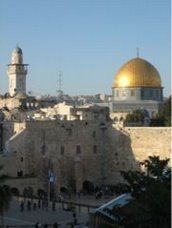
just seems right that I should walk by a piece of Solomon's temple on
my way to breakfast, eat lunch within view of Islam's third-holiest
site, and sit at a computer on the street where Jesus carried his
cross, all before hopping on a jet plane to return home this evening.

Our team made the short bus ride from Hebron to Jerusalem on Friday
morning, just in time to find a falafel sandwich and get over to
Sabeel. It took a while to readjust to lunch prices back in Jerusalem
- a falafel sandwich jumped from 3 sheckels (75 cents) to 6 scheckels
(a buck fifty). Then our final appointment of the trip brought us to
Sabeel, an organization of Christians who have lived in the area
anywhere from a couple hundred to a couple thousand years. They see
this conflict as a continuation of violence which began long, long
ago. The Germans were exploited and destroyed after WWI, then they
exploit and destroy Jews during WWII, and we see the same process
developing again in Israel's policies toward arabs. Their work is to
end this cycle, working with both the Palestinians, so this cycle
stops here, and the Israelis, who are imposing an occupation that is
"illegal, immoral, and destroying lives on a daily basis." Before I
left the U.S., I didn't realize that the local population had been 20%
Christian before 1948, and that they suffer alongside their fellow
arabs in this conflict. In fact, we've met Christian communities in
Bethlehem and Jerusalem who describe their struggles to continue their
lives under occupation. In fact, there's a Christian village north of
Jerusalem I haven't visited yet, but which has endeared itself to me
in a special way. They produce the West Bank's only micro-brew.
Honest. It's called Teybeh (pronouned tie-bay), and I think it's also
being made now in England, so we may be able to find it in the states.
You see, one gets all kinds of important information on a trip like
this.

Once in Jerusalem, I was able to visit the Holocaust museum and
Masada, two of the most important symbols for today's state of Israel.
If you're like me and are unfamiliar with Masada, it's the site of
the Jewish rebels last stand against the Roman army in their revolt
around 70 CE. What's more impressive is that the "last stand" lasted
over 2 years. We took the bus there, and as you approach it from the
Dead Sea, you can see how they held out so long - it's a massive
stand-alone tower of rock over 600 feet high with about 2 or 3 acres
of flat space on top. The roman army eventually built a ramp to the
top, and when they entered, the entire troop of rebels had committed
suicide. Today, the Israeli army holds its swearing in ceremony at
Masada, saying that 'Masada will never fall again.' One can see why
it would appeal to the national consciousness, especially to notice
how many people walk around carrying their firearms with them.

After getting to know more about the situation, the bus ride from
Masada back to Jerusalem was a different experience than it would have
been two weeks ago. I could see large groups of stumps on the side of
the road, which I now know represent the olive trees of an arab
village that used to be here. I also noticed how access was blocked
to our highway, keeping the local arab population from using the new,
large road. Simply a couple of details in the larger story.

Probably the most valuable experience in Jerusalem (aside from the
multiple loaves of pita with hummus) was visiting the Holocaust
museum. It was there that I felt a real sense of clarity about the
roots of the problem. How can one comprehend the effect of looking
complete annihilation in the face? Not only for yourself and your
family, but for your entire culture? The horror was unbelievable. I
don´t think there´s any way I can judge them for doing 'whatever it
takes' to secure a safe homeland, where they could protect themselves
and their children from such mindboggling violence. The museum is
excellent, and for anyone who visits Israel it should be required
viewing.

My sadness and disgust looking at the displays was accompanied by a
real frustration. Certainly nobody is currently being sent by the
thousands to gas chambers, but the parallels with the early stages of
persecution is striking. I wrote down some quotes that echo so
closely with what I´ve seen:
'In Eastern Europe, the Germans incarcerated the Jews in severly
overcrowded Ghettos, behind fences and walls. They cut the Jews off
from their surroundings and sources of livelihood, and condemned them
to a life of humiliation, poverty, degeneration and death.'
'Despoiling the Jews was an integral part of Nazi policy. Property
and possessions of Europe´s Jews, who had been part of their
countries´ economic and cultural life for hundreds of years, were
systematically plundered. With their rise to power, the Nazis
progressively began banishing the Jews from economic life, and, in
1938, established confiscation of Jewish property into law.'

Many more bore shocking resemblance to what I saw in the West Bank.
The government declares land to be 'state land' even when it belongs
to a Palestinian, a village, or even if there are homes on the land.
Then some very zealous religious folks set up a camp on the land and
call it a 'settlement.' Since the Israeli military is sworn to
protect the settlers, the army moves in and sets up fences, guard
towers, and a constant military presence. The Palestinian land owner
now has no recourse. His crops will likely be destroyed, his property
gone, and his safety threatened. There is no accountability for the
actions of the settlers. They can invade his home, attack his family,
and destroy his livelihood (all of which we saw in our visit to a man
near Hebron, as well as our visit to the village of At-Tuwani). The
army, you see, has no jurisdiction over settlers. It sets up a
situation where the Palestinian landowner has no recourse whatsoever,
and the new settler community has complete free reign to do whatever
they want. If they happen to believe that God wants them to abuse,
oppress, and destroy others for the sake of a 'greater Israel', then
there is nobody to stop them. Add to this the bureaucratic system
that leads to the policy of home demolitions, and this situation is
helpless. To build an addition to your house for your family, or to
build a house on your own property, you need a permit from the
government. Palestinians, as a rule, are unable to get these permits.

The stories of cruelty from these West Bank areas leave me speechless.
It would be unbelievable if I hadn´t seen the 9 year old girl with
3rd degree burn marks on her face, or seen the place where CPT members
were beat with chains while accompanying children to school, or seen
picture after picture of family members killed by the military - many
of them just children, or seen the piles of rubble that had been
simple family dwellings up until June 3 of this year. The tales of
violence go on and on and on. And it seems that, up until now, these
policies have successfully stayed under the radar of Western media.
It´s successfully been portrayed as a necessary security measure in
order to force the arab population to denounce violence. Now, as
someone who has seen the facts on the ground for myself, I am
convinced that this is a good old-fashioned land grab, disguised for
the sake of well-intentioned Israelis and Americans who would only let
it continue if it was necessary for ´security´ or if it can be framed
as a religious struggle between the good guys and the bad guys.

If this situation is to be resolved peacefully, it will require all of
us to look more closely and critically. We must be willing to be
critical of the party in power, especially when their policies allow
for such wanton violence against their fellow human beings. One
striking quote from the Holocaust museum still echoes in my head: ´The
rest of the world considered the persecution of the Jews to be an
internal German matter.´ I feel we have the opportunity to step into
this cycle and call for honesty, accountability, and justice for all
the residents of this land. If Israel is to have a future, it must
end these policies of the occupation that create ghettos, second-class
citizens, poverty, and violence.

Ah boy. There I go preaching. It´s hard to avoid, though. There is
such pain in this land, and there are policies that continue to make
it worse. That´s one reason I´m ready to get home - I want to
contribute to our understanding of the conflict in the U.S. I think
by learning more about it, we will better be able to contribute in
ways that hold all parties accountable to our values of freedom and
justice.

Another reason I´m ready to get home: the traditional style toilets.
Or rather, the lack thereof. To a westerner like myself, it felt like
they just forgot to install the seat and the bowl. This is one
difference with western culture that I do not think we need to adopt.
The first few times, it was a neat cross-cultural experience. Okay,
just the first time, really. How quickly it became a pain in the
neck. And elsewhere. There´s apparently a learning curve, and one
can gain skill at negotiating this hole in the floor. My hats off to
all those who have learned this skill. I leave admitting defeat in
this area.

Okay, I'm off to one last falafel sandwich, then to the bus and the plane.
Peace to you,
Andy


My 15 minutes of lavish fame:

Salt Lake Tribune
Utahn Heads to Middle East
http://www.sltrib.com/search/ci_6098910?source=email

Friday, June 8, 2007

Israel/Palestine Update 2 - Hebron

Hello friends,

I send greetings from the end of a massive week. We've traveled all
around the southern part of the West Bank, into the Negev desert, out
to a tiny village, through grape fields and checkpoints, and
underneath a church or two. We've sat on mats on the floor, plastic
chairs under tents, small pillows, conference chairs, and futons.
We've had more cups of tea and coffee than I've had in the previous
four years combined. Before leaving, I was concerned about finding
any computers with the internet so I could send regular updates.
Turns out the technology isn't in short supply here. (I'd heard that
Muslim women typically walk with their eyes turned down - actually,
they're just dialing.) No, the difficulty has been time and energy.
When I have a moment to spare, I seem to wind up sleeping or eating.

Nonetheless, I'm really excited to pass along a bit of this experience
if I can. An attempt to cover everything we've done would just be
absurd. We've seen so much and talked with so many people, that it
could never do any of it justice to try covering it all here. I would
simply end up giving you such an abbreviated version, that the most
important element would be completely lost - the depth and complexity
of this land, this people, and this conflict. In fact, one of the
biggest problems with the treatment of Israel & Palestine is just that
- it gets skimmed over too quickly and we have to make rash judgments.
So I'll try to narrow it down a bit, hoping to give you a taste of
this experience, and I'll save most of the information and stories
we've heard for my return.

First of all, I have to say that this is not what a lot of folks
(including me) expected me to encounter. I think I subconsciously
envisioned some sort of burned out war zone where walking down the
street to a restaurant required a stroll between AK-47-toting
Palestinian protesters and Israeli attack helicopters. Turns out that
instead of dodging bullets I'm dodging swarms of 7-year-old kids in
the marketplace practicing their three words of english on me over and
over and over "Hello! Welcome! Howareyou!" In fact, I've noticed a
number of things about Hebron that remind me very much of my
small-town North Carolina upbringing. Indeed, West Bank life and U.S.
country life seem to be surprisingly similar in a number of ways:
- Everyone honks and waves as they pass on the road.
- Drivers have no qualms about stopping their vehicle in the middle of
the street to carry on a conversation with one another.
- Children have no fear when it comes to climbing on top of dangerous
places - dumpsters, buildings, moving vehicles...
- Drivers don't let little things such as potholes, curvy narrow
roads, or oncoming traffic keep them from living out their Nascar
dreams.
- The dogs have no names.
- The tea has enough sugar in it, even for a southerner. (It just
happens to be served hot instead of iced.)
- You will not leave a house hungry.
- In a given valley, every household is related to one another.
- The family web of relationships is still the way business gets done
(see the story about the Hebron police below...)
- One may occasionally pass someone who is carrying a really big gun.

Yes, amongst all this familiarity is the reality of the occupation. A
green humvee, a building in downtown surrounded by high fences and
armed soldiers; it's all just another piece of daily life in Hebron.
We spent some time with the full-time Hebron CPT team as they walk
with schoolkids through the military checkpoints to school. They
stand there to make sure the schoolkids aren't harassed by either
soldiers or settlers, who also use this one stretch of road. This
morning was pretty quiet. Only one settler who passed by acknowledged
our presence (which he thankfully did by only spitting toward our feet
instead of toward other, more saliva-sensitive body parts.) My
U.S.-born tongue briefly considered offering him some good ol'
southern sass, until the semi-automatic assault rifle slung over his
back convinced me otherwise. I watched him shuffle quickly on down
the road, like a middle-age businessman late for an appointment, and
as the gunbarrel bounced merrily against his back pocket I thought,
Yes, it's a crazy situation here.

We've met with a leader from a refugee community (and slept in his
flat with his family inside the camp), a Jewish family in a settlement
outside Bethlehem, Bedouin families uprooted in the desert, a woman
running a preschool in her apartment (against ALL the odds), many
human rights and nonviolent resistance organizations, and a village
elder from one of the worst areas of violence with local Israeli
settlements. A couple of highlights have been the local Hebron police
and the nonviolent grapefield action.

We had the chance to meet with the local Palestinian police force in
the Old City of Hebron. This isn't the occupying Israeli force - it
was established as an observation team about 12 years ago, and became
a real police force not long after. The problems of crime and drugs
were on the rise in the old city, and this police force has been
successful in lowering crime and making the old city market a safe
place again. The trick is, they did it all with NO WEAPONS. That
blew me away. Since they're Palestinian, they aren't allowed to have
any weapons whatsoever for their police work. Cops with no guns. I
asked how they did it. Turns out, since everybody knows everybody
(and their family), they use the web of relationships. If they find
out who just broke into a storefront, they call his grandmother. No
kidding. Then the family addresses the problem, maybe helps the young
man find a job, or just uses that grandmotherly influence to
straighten everything out. It seems that organized crime is still no
match for the organized grandmama network. If I had any professional
television production skills at all, I'd be back here in a heartbeat
to film "Hebron 9-1-1." Sitting in that small, smokey police office,
listening to these strong, confident men and drinking the coffee they
offered us - definitely one of the trip highlights for me.

The other quick peek into our delegation came last Friday. We went to
the Holy Land Trust, a center for nonviolent resistance to land
confiscation and the occupation, where we spoke with the staff for
about 30 minutes. Then, we piled on a bus with about 20 other people
and drove to the outskirts of town. There were about 60 people in
all, Palestinians and internationals, standing in a gravel road
looking across the valley at a small grove of trellised grapevines.
At the bottom of the valley was a newly-graded gravel road, which was
to become the foundation for the separation barrier. When I looked
toward the top of the hill and saw the small silhouettes of soldiers,
I admit my heart skipped a beat. Our plan was to walk across the
barrier and into the confiscated grape field, accompanying the farmer
who owned the land while he tended his crops and picked some of the
leaves. Our team discussed at length the action, emphasizing that we
should only participate in the illegal parts if we were comfortable
with it. Nearly half our team remained behind (somebody needs to be
there with cameras and bail money, you know), and the others walked
with the group down the hill, across the gravel boundary, and up the
other side. We were followed closely by a camera crew, since a big
part of this kind of action is to make public the injustice of the
barrier construction as it winds through the countryside, cutting this
farmer off from his remaining cropland. The soldiers moved a little
closer, but still remained near the top of the hill. I was kind of
annoyed. You see, a big purpose of such an action is to encounter
these soldiers face to face, which meant we had to trudge our way all
the way up that dang hill. Turns out they allowed us to spend a
couple of hours in the field without any sort of harrassment.
Apparently, after weeks of similar nonviolent actions, this was the
first time there had been no conflict. After a little while, the mood
had lightened significantly, and some of the soldiers pulled out their
cell phones to get our picture. The protest leader and the lead
soldier knew one another on a first-name basis, and they chatted for a
while. Some smiles broke out among the soldiers, and I began to feel
sorry for them, standing there in all that gear in the heat. You
could tell that most of them, by the looks on their young faces, would
much rather be at home talking about baseball with their pals, and
they don't like this situation any more than we did. A few settler
boys showed up at the top of the hill and taunted us in Hebrew, but
they eventually wandered away. After this day, I had no doubt that
strong leaders exist in Palestine, and given enough time, they will
successfully overcome the occupation and create a place where the two
cultures - Arab and Israeli - can live together peacefully. I'm just
hoping that everyone doesn't blow one another to pieces before we can
get there.

Okay, it's now late. I'm 7 to 9 hours ahead of you folks, so I'm
going to hit the sack. Thanks again for everyone's prayers and well
wishes - I don't take any of them for granted!

God's peace to you,
Andy

PS - I put up just a couple of pictures at
www.johnstonontheweb.blogspot.com the other day. Hopefully I can get
more up soon!

Monday, June 4, 2007

Pics from the Action Site


This first picture comes from our tour of Jerusalem. You can see the barrier in the background - at this point a 20 foot high concrete wall.


These following pictures are all from the nonviolent protest action we participated in on Friday morning. We traveled with the Holy Land Trust outside Bethlehem, where the wall is being constructed through a local farmer's olive and grape field. We went to spend time in the field while Nassar, the farmer, harvested his grape leaves and did a little weeding. You can see below the soldiers who came to confront us. This was the first time the soldiers did not interfere, and the morning finished without incident.


This is the barrier foundation, having been run through the countryside outside Bethlehem. The next picture shows some teenagers who came from the local settlement to yell things at us in Hebrew. Probably a lot of words not found in the Psalms.

Friday, June 1, 2007

Israel/Palestine Update 1 - Bethlehem

Hello friends,
I'm sitting here early on Friday morning, and like many Mennonites and
Amish before me, I'm questioning the real benefits of modern
technology. With the wonder of electronic amplification, one can hear
every single mosque in town broadcast their 4:00am call to prayer. It
comes all at once, like a choir singing with different sheet music.
The Muslims of town may or may not respond with private prayers in
their homes, but the rooster and dog who live right across the street
share none of their modesty. Maybe they are Christian and they take
the verse literally that calls one to praise loudly at the top of your
voice. Then when the Christian church rings its bell around 5:00am,
this only inspires their zeal for proclaiming, as one would expect
from such pious animals. It's quite impressive they would continue to
have such enthusiasm for an event that happened yesterday, the day
before, and pretty much every day for hundreds of years. Combine this
noisy chorus with a jet-lagged internal clock, and here I sit.

My jet lag hasn't been too bad. Once you live with a medical
resident, your perspective on sleep deprivation changes drastically -
it's much easier to say to yourself, "Suck it up, it ain't gonna
killya." I landed at 5:00pm Tel Aviv time on Wednesday (which is 7
hours earlier than the east coast) and had began preparing myself for
passport control. I'd heard lots of horror stories; people being
detained for hours, grilled and questioned over and over about why
they're coming, who they're going ot see, and more than once being
denied entry. I started getting a bit nervous, until the airplane
speakers started pumping "I'm hooked on a feeling..." It's sort of
difficult to be intimidated about anything with such cheesy 80's music
as the soundtrack. Sure enough, I walked up to the young woman
checking passports, made some crack about my hair, and they let me
through with nary a question.

In the airport I met up with four other CPT team members, and we
hopped onto a minivan taxi for the 25 mile ride from Ben Gurion
airport in Tel Aviv to Jerusalem. I was immediately struck by the
beauty of the place. First of all, the airport was stunning. I
especially enjoyed watching all the families reunited and friends
running to embrace one another at the exit area. What an amazing
level of diversity - so many languages and ethnicities, all talking
loudly with big smiles. There was also a large contingent of holy
land tour members, all of whom had the eager look of people trying to
find their spiritual roots or just their tour guide. On the taxi
ride, we dropped off some people in the orthodox areas of Jerusalem,
and it was a thrill to see entire communities in the traditional black
attire and haircuts. I even caught a glimpse of a young man with the
distinctive aspect of down syndrome wearing the traditional black hat
and suit, apparently integrated right into community life. Seeing
this amazing mix of conformity, heritage, and international diversity
in Israeli society, plus seeing a few neon signs in hebrew, really
brought home that I was in a different place. On that ride, I found
myself excited about the entire Israel project - where else has such
diversity been brought together in one place? Such deep heritage
combined with a truly world-wide diversity makes this a region with
incredible potential. One could live right beside a Christian, a Jew,
and a Muslim, each from far, far away or from a local community dating
back centuries. The taxi dropped us off at the Damascus gate, leading
into the Old City of Jerusalem. Once we crossed underneath this
massive stone structure, it was like passing into another era. The
"main" street was no wider than an alleyway, and the architecture was
that distinctive mish-mash of really old cities, where everything has
been added on and rearranged in a chaotic pattern. It was all made of
stone, and with the rattle of Hebrew and Arabic from the street
vendors, I felt like I was in a movie.

The other reality was also present, seeing heavy barbwire and tall
guard towers as we briefly passed through the West Bank on our drive
from the airport. The reality is also present here in my writing,
giving me an extra challenge in relating my experiences to you.
Before I came, CPT told me that there are no fewer than three
governments interested in what I say from here, and I can just assume
they are listening. I thought it sounded a little
conspiracy-theory-ish, until the experience with the coffee shop. CPT
published a short article on a small Palestinian coffee shop that
re-opened its doors to business in the Hebron Old City, despite the
fact that all the other businesses have closed down due to the
presence of settlers and soldiers keeping customers away. They told
the owner's story, using the name Mohammed as an alias. Not two weeks
after the email report came out (sent via email to CPT folks), some
soldiers came into the shop looking for a "Mohammed" and for the
author of the article. Finding neither, they eventually left. Two
other CPT members were in the shop at the time, and reported the
incident in a later post. Hey wow, they're really keeping tabs on
this stuff. So welcome to any of you checking in from any special
agencies; glad to have you along. I have heard about a number of
other incidents since arriving - any information connecting a
Palestinian to a western organization like CPT can put them under a
great deal of harrassment and danger. Therefore, I'm unable to tell
you about the wonderful family with whom we're staying now. Maybe
when I get home and figure out a good and safe way to work with
pseudonymns and such, but we'll see. Just take it from me; wonderful
hospitality.

Thursday was the day of overwhelming. In the morning we took a quick
minivan tour around Jerusalem with Angela from the Israeli Committee
Against House Demolitions. We got to see the new security fence
cutting through parts of East Jerusalem - the Palestinian side. In
this part of town, it is a striking picture: 12meter high concrete
with razor wire on top. We saw the empty gas stations along a
once-busy highway which was completely blockaded by the wall, and the
rubble from a home torn down in order to build it. We saw new
settlements being built in the Palestinian areas, and 88 homes all
with demolition orders waiting to be filled because they are in an
"archeological zone" where King David once walked. The litany of
legislation and the long, methodical story behind occupied East
Jerusalem nearly became too much. By the time we finished the tour,
I'd stopped trying to keep up with all the details - they just run
together after a while. Then in the afternoon, we met another Israeli
organization called B'Tselem. They pursue legal responses to these
injustices and also work to change the government policies toward the
Palestinians, with only moderate success. At the end of the day, it
is nothing less than overwhelming.

Since there are many folks on this list who are, like I have been,
unsure about the conflict here, I want to tell you about my mindset
now. I came with many questions; first of all I wanted to find some
sense of discernment about what's actually happening. So much of the
literature I found in the U.S. seems to be propaganda for one side or
the other, I wanted to find out some truth first-hand. Now, in just
the briefest time here, I have seen it for myself; seen where the
security fence plows through neighborhoods, cutting Palestinian
Christians and Muslims off from their schools and work; seen
settlements being rapidly built on land outside the official state of
Israel; seen the stumps of entire fields of olive trees cut down for
being too close to a new highway - one of the highways in Palestinian
territory but closed to Palestinians; seen the ruins of houses plus
some of the nearly 1,000 homes with outstanding demolition orders in
Jerusalem alone. Make no mistake nor excuse: the injustice is clear
and real. It does indeed have direct similarities to the stories from
South Africa, from the pre-Civil Rights southern U.S., from
(ironically) the Warsaw ghetto, and other situations of control -
where one party has great power and works to control and exploit a
party without power. And the spiritual reality - if you believe in
such - is palpable. Even a bone-head like myself can pick up on the
draining sensation present on the line seperating the occupied
territory from Israel proper. There are unique elements here, to be
sure, but I have no more question that the principalities and powers
behind the policies and occupation of Palestine are destructive and
wrong. "That ain't right," to borrow the eloquent phrase of an
Atlanta friend.

Now, the challenge is how to call a spade a spade, stand up against
clear injustice (as my faith demands), and still keep an open mind
about the future. This is clearly not simply a good guys/bad guys
affair, and there is beautiful potential for what can happen with
Israelis and Palestinians. Yet the current situation is being
corrupted by policies which, under the all-powerful reasoning of
"security," are confiscating land, preventing Palestinians from
working, dividing them from their families, and creating poverty and
despair. I still hope to remain open to discernment while here, but
to ignore these clear examples of injustice would be, to use a phrase
from Dr. King, a bad case of "analysis paralysis." Open-mindedness
cannot mean becoming frozen in a neutral, passive state in the face of
evil. If I remember correctly, Jesus did love and respect everyone,
but that never stopped him from standing up and acting decisively for
the sake of real justice. The remaining question is "how to respond?"
Violence obviously doesn't do anyone any good - just look at current
events in Gaza and Lebanon. This will be the next question I want to
think about while over here - how does one deal with this? Especially
as an outsider from another country?

First of all, I can deal with it by respecting the tradition of
hospitality in Palestine, and continue eating myself sick at every
meal prepared for us. Grape leaves, hummus, pita... I do this for the
sake of world peace, of course. And the falafel stand for lunch
yesterday: scrumptious. Every one of you should be really jealous
that you didn't get one of these sandwiches. I have worked hard to
earn the reputation as someone who can help finish off another's
leftovers, and sister Jean and I have formed a wonderful symbiotic
relationship. She is a Maryknoll sister who worked in Japan over 50
years, and doesn't like to see food go to waste. We get along great.

Okay, sun's coming up. I'm signing off for now. God's peace to you,
Andy

PS - For those new to the list, here's the website for previous posts.
I also hope to get some pictures up there soon.
www.johnstonontheweb.blogspot.com